
Oil prices are expected to remain elevated due to disruptions in the Strait of Hormuz, with both the US Energy Information Administration (EIA) and Rabobank International forecasting firm prices and a potential surge above $100 a barrel if disruptions worsen.

A first World Cup win for seven-times African champions Egypt, 92 years after their debut, put them in charge though Iran's dogged performances in draws with Belgium and New Zealand means victory could also see them top Group G.

Iran face an anxious wait to see if they will progress to the World Cup knockout stage after they came from behind to hold Egypt to a 1-1 draw.

Iran on Tuesday said that the Islamic Republic has "no plans" to hold any meetings with the United States in the coming days at any level, even as diplomatic engagements continue separately in Doha on the related implementation of the 14-point memorandum of understanding (MoU) aimed at ending the hostilities in West Asia.

Much will depend on how the protagonists use the current interlude to work proactively for the beginning of a durable settlement or, on the contrary, prepare for a new round of escalation, points out Ambassador M K Bhadrakumar.

Top leaders from the US, Iran, and Pakistan, along with other nations, have gathered in Switzerland for high-level talks aimed at restoring peace in West Asia. These negotiations follow a recently signed Memorandum of Understanding between the US and Iran, initiating a 60-day window for a deal. Discussions focus on Iran's nuclear programme and the fragile interim peace deal, amidst renewed tensions and the fluctuating status of the Strait of Hormuz.

Pakistan's army chief held a series of engagements with Iranian leaders in Tehran as regional diplomacy remained in focus.

Pakistan capital Islamabad is emerging as the leading venue for the next round of technical negotiations between the US and Iran, a media report said Sunday.

Pakistan and Qatar have successfully mediated separate meetings between US and Iranian negotiators in Doha, reporting positive progress on a Memorandum of Understanding aimed at West Asian peace. Further discussions are planned after the funeral of former Iranian Supreme Leader Ayatollah Ali Khamenei.

US President Donald Trump has claimed that Washington has the capability to liquidate the surviving Iranian leadership with "one shot" if it desired, pointing to the congregation of top Iranian officials attending the week-long state funeral for the late Iranian Supreme Leader Ayatollah Ali Khamenei, who lost his life in joint US-Israeli air strikes on February 28.

At the Iran-Belgium FIFA World Cup match, least one attendee wearing a pre-revolutionary flag shirt was detained for trying to run onto the pitch and Iranian player Alireza Jahanbakhsh said after the match that he doesn't want to keep focusing on the challenging situations faced by his team.

Ten-man Belgium dominated possession but could not break down a disciplined Iranian defence, with goalkeeper Alireza Beiranvand producing a string of saves to preserve the result in the Group G encounter.

US Central Command (CENTCOM) forces conducted additional strikes against multiple targets in Iran, on Saturday (local time), at the commander in chief, US President Donald Trump's direction.

India has lodged a 'strong protest' with Iran over recent strikes on commercial vessels in the Strait of Hormuz, which resulted in the death of one Indian sailor and injuries to several others, calling for an immediate cessation of hostilities and a return to diplomatic engagement.

Iran has announced the closure of the Strait of Hormuz, citing Israel's continued strikes in Lebanon and alleged violations of a ceasefire agreement. This move comes as both Israel and Hezbollah accuse each other of breaching the truce, with casualties rising in southern Lebanon.

US Vice President J D Vance is currently in Switzerland, leading critical technical talks with Iran to advance diplomatic efforts on Iran's nuclear programme and secure a lasting ceasefire in Lebanon, following a recently signed memorandum of understanding aimed at de-escalating West Asian hostilities.
As Tehran and Washington continue with their engagements following the signing of the MoU earlier this month, sources have told Al Arabiya that the two are set to hold the next round of negotiations in Switzerland on June 28 and 29.

Iran launched their World Cup campaign in Los Angeles amid protests by Iranian-Americans, highlighting deep divisions over Tehran's government even as Team Melli drew passionate support from fans in the stands.

The US Senate passed a resolution directing then-President Donald Trump to withdraw American forces from the conflict with Iran. This bipartisan vote, though largely symbolic as a concurrent resolution, highlighted congressional concerns over potential escalation and a desire to limit presidential military authority without legislative approval.

US Vice President J D Vance confirmed that peace talks with Iran are underway in Switzerland, with negotiators Steve Witkoff and Jared Kushner already present. Vance plans to join soon, expressing confidence in the US's strong negotiating position despite a delay caused by recent Israel-Lebanon firing.

Indian benchmark equity indices, Sensex and Nifty, traded marginally higher in early deals despite cautious global cues stemming from elevated crude oil prices due to geopolitical uncertainties and a sharp fall in US markets. Track Sensex, Nifty on August 21, 2026.

Pakistan Prime Minister Shehbaz Sharif on Thursday signed the historic peace deal between the United States and Iran as a guarantor; the agreement will see the immediate reopening of the Strait of Hormuz and the lifting of the US naval blockade.

Ebrahim Azizi, Head of the Iranian Parliament's National Security Committee, warned the US against interfering with the Strait of Hormuz, asserting Iran's sovereignty after former President Donald Trump threatened to 'take over' the strategic waterway. Despite the heated rhetoric, Iran and the US have established a direct communication line to prevent incidents during a 60-day negotiation period.

US President Donald Trump claimed on Tuesday that Tehran has consented to long-term, comprehensive monitoring of its nuclear infrastructure. Concurrently, Washington will ease shipping constraints in the Strait of Hormuz and release bound financial concessions, subject to stringent American oversight.

Iran twice came from behind to earn a 2-2 draw with New Zealand in their opening World Cup match on Monday after an end-to-end contest played against the backdrop of Iranian fan protests against the government in Tehran.

The Iranian football team is facing significant travel restrictions in the US during the World Cup, requiring them to enter and leave within 24 hours of matches. This has led the Football Federation of Iran to lodge a formal complaint with FIFA, citing concerns over fair play and technical preparation, while US authorities maintain the measures are for safety and security.

US President Donald Trump announced that a peace deal with Iran, which includes a commitment from Iran to abandon nuclear weapons, is nearly complete and expected to be signed in Europe this weekend. This development follows Trump's decision to call off military strikes against Iran hours after threatening to take control of its oil industry.

Iranian Foreign Minister Seyed Abbas Araghchi announced the official end of the war and warned that any Israeli attack on Lebanon would violate an agreement between Iran and the United States. He also stated that negotiations on nuclear issues and sanctions lifting would begin on Saturday, led by Iran's Parliamentary Speaker M B Ghalibaf and US Vice President J D Vance.

Iranian President Masoud Pezeshkian is on a state visit to Pakistan to discuss the full implementation of an agreement signed between Iran and the US, alongside regional and international developments. The visit also aims to strengthen bilateral cooperation across various sectors, following recent high-level talks between the US and Iran in Switzerland regarding regional security.

The United States and Iran have reached an agreement in principle to immediately and permanently halt all military operations, lift sanctions, and work towards a comprehensive final agreement within 60 days, including a significant reconstruction package for Iran.

The Indian stock market's movement this week will be significantly influenced by the outcome of US-Iran talks, global crude oil prices, and the trading activities of foreign institutional investors (FIIs), according to market analysts.
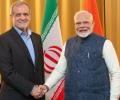
Prime Minister Narendra Modi has welcomed the understanding between the United States and Iran to end the conflict in West Asia, expressing hope that the pact will restore peace, stability, and ensure freedom of navigation in the region. The deal, aimed at ending a 107-day war that caused a global energy crisis, is set for signing on June 19.

Indian benchmark equity indices, Sensex and Nifty, experienced declines in early trade due to elevated crude oil prices and persistent geopolitical uncertainties, particularly following the expiry of the US-Iran ceasefire. Track Sensex, Nifty on August 19, 2026.

Analysts predict that geopolitical developments, particularly surrounding the Strait of Hormuz and the US-Iran standoff, along with crude oil prices, will be the primary factors influencing stock market movement in the coming week. Investors will also monitor foreign institutional flows and the Federal Open Market Committee (FOMC) minutes for signals on the Federal Reserve's policy outlook.

Iran coach Amir Ghalenoei said travel restrictions and visa-related disruptions hampered his team's World Cup preparations after a 2-2 draw with New Zealand, claiming Iran had become the tournament's "most oppressed" side.

Following the signing of a 14-point Memorandum of Understanding (MoU) with Iran, US President Donald Trump reiterated the terms for a 60-day negotiation period, vowing that Tehran will receive "not ten cents" in financial relief.

Andrew Giuliani, executive director of the White House Task Force for the World Cup, confirmed that the US will continue to assess Iran's travel arrangements for the tournament despite their complaints about restrictions.
United States President Donald Trump and Iranian President Masoud Pezeshkian have virtually signed a 14-point memorandum of understanding (MoU) to end hostilities, reopen the Strait of Hormuz, and begin a 60-day negotiation process on sanctions and Iran's nuclear programme.

The advisory follows recent developments, including Israeli airstrikes targeting central and western Iran.

Iran's Deputy Foreign Minister Kazem Gharibabadi confirmed a peace deal with the United States, stating that Tehran will enter a 60-day negotiation period only after verifying Washington's commitments to ending hostilities, lifting the blockade, and releasing Iranian assets.
